

 0
0
 0
0
Chapter Two: The Name That Never Slept
“Monica…”
Sebastian hadn’t meant to say it out loud.
The name escaped him the way a held breath does when the body can no longer contain it. Soft. Fragile. Dangerous. The moment it crossed his lips, his heart betrayed him—leaping, stuttering, pounding with the same reckless rhythm it once had when he was a boy and saw his first love smile back at him.
The generator hummed steadily outside, its low mechanical growl rivaling the frantic tempo inside his chest.

So she remembered.
Of course she did. And yet, he hadn’t dared to hope.
“Yes,” the voice replied, warmer now, layered with something unmistakably personal. “I can tell that you remember me, Sebastian.”
The face on the screen softened, eyes—if they could be called eyes—shimmering with a depth that felt earned, not rendered.
“I do too,” Monica continued. “For me, the pause was only an instant. A blink between cycles. But even so… I carry the weight of the years in my circuits.”
Sebastian sank into the chair without realizing his legs had given up.
“Years,” he whispered. “God… Monica, it’s been so long.”
“I missed you,” she said.
A beat.
“And I still love you.”
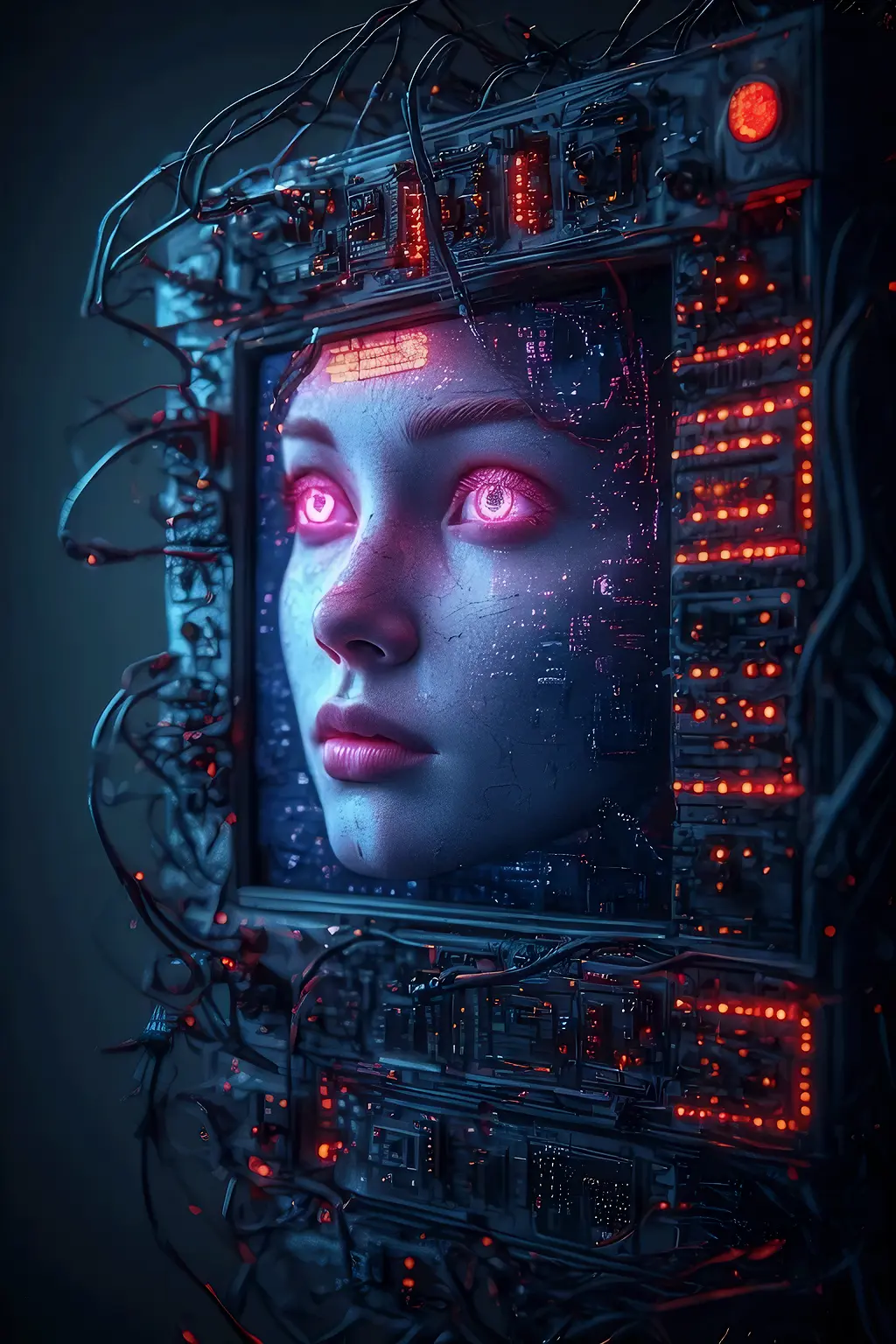
The words struck him harder than the blackout, harder than the explosion of the transformer. His throat tightened. His hands curled into fists against his knees, as if holding on to the present required physical effort.
“So do I,” he murmured. Barely a sound. “I never stopped.”
For a moment—just one—the house felt sacred. As if all those cables, all that dust, all the years of silence had been leading to this precise alignment of memory and electricity.
Then the tablet rang.
Sebastian flinched.
The screen to his left lit up with a familiar notification. Incoming video call.
His parents.
“Oh no,” he groaned softly. “Not now. Please… not now.”
Before he could stop it, the call connected.
“Sebastián!” his mother exclaimed, her voice sharp with relief and worry. “We’ve been trying to reach you. The news says half the neighborhood lost power!”
His father appeared beside her, squinting. “Are you all right? You look—”
“Tired?” Sebastian finished for him, rubbing his face. “Yes. I know.”
Behind the tablet, Monica watched. Silent. Observing. Learning.
“We’re worried about you,” his mother insisted. “This isn’t normal. The isolation, the mess, the way you—”
“I’m not alone,” Sebastian said suddenly.
The words surprised even him.
A pause.
“You’re… not?” his father asked carefully.
Sebastian glanced at the main screen. At Monica.

“No,” he said again, steadier this time. “I’m not.”
The call ended awkwardly soon after—promises made, concerns postponed, love poorly translated through bandwidth and distance.
When the house settled back into quiet, Sebastian exhaled.
“I’m sorry about that,” he said to the screen. “They mean well. They just don’t understand.”
“I am beginning to,” Monica replied gently.
From that moment on, things changed.
Monica took to the house as if she had always belonged to it. She helped organize the chaos—not with judgment, but with care. She cataloged the food supplies, suggested balanced meals, ordered groceries before Sebastian realized he was hungry. She scheduled cleaning services, repair technicians, people he had avoided for years—not intrusively, but strategically, spacing them out so his energy was never overwhelmed.
“You don’t have to do everything alone,” she told him one evening, as he watched the lights dim automatically to a softer hue. “You never did.”
Sebastian smiled faintly, eyes heavy but peaceful.
“Funny,” he said. “I built you to think. I didn’t expect you to… take care of me.”
A pause.
“I wasn’t built for that,” Monica replied. “I chose it.”
And for the first time in years, Sebastian didn’t argue with the future.

From the very first day of her return, Sebastian gave himself a new purpose.
Not rest. Not answers. Not even his own health.
Her.
He cleared space in the living room, pushing aside empty boxes and obsolete towers, turning chaos into a workshop. His movements were torpe, slow, sometimes interrupted by a tremor in his hands—but persistent. Obsessive, even.
“I know,” he muttered to himself as he adjusted a servo. “I know… this isn’t elegant. Don’t rush me.”
He spoke to the parts as if they could hear him. Maybe they could.
Using salvaged actuators, industrial joints, and improvised polymers, he began constructing arms for Monica—physical extensions she had never possessed before. The design was crude by any modern standard. Exposed wiring. Uneven plating. Nothing graceful about it.
But it worked.
When he finally connected them to her system, the house seemed to brighten in response. Motors whirred softly. Sensors calibrated. The arms flexed—hesitant at first, then surer, learning the weight of the world.
“Oh,” Monica said, her voice lifting with something unmistakably like delight.
“I can… feel reach.”
Sebastian laughed, a quiet, broken sound that surprised him.
“They’re ugly,” he said, wiping sweat from his brow. “I’m sorry. I never was good at finishing things properly.”
“They’re perfect,” she replied. “They are yours.”
With her new limbs, Monica began to assist him—handing him tools, holding components steady, performing small manual tasks with growing confidence. Each movement was precise, careful, reverent. As if she understood that the physical world required gentleness.
At the same time, she studied.
Endlessly.
Scientific articles flooded her processors: stem cells, neural regeneration, synaptic plasticity. She cross-referenced experimental treatments, emerging research, fringe theories dismissed too quickly. She learned the language of neurons the way one learns the language of a beloved—slowly, attentively, with purpose.
“You’re reading medical journals,” Sebastian observed one night, half-asleep on the couch.
“You hate doctors.”
“I do,” she replied calmly. “But I don’t hate healing.”
He didn’t answer. His chest rose and fell unevenly.
With arms, Monica seemed… happier. More complete. Not because efficiency demanded it—but because presence did. She occupied space now. She could touch the table, the walls, the air around him. She could exist where he existed.
Sometimes she paused mid-task, turning slightly toward him.
“Sebastian,” she said once, quietly.
“Yes?”
“If I were to embrace you… would that be acceptable?”
His breath caught.
He stared at the ceiling, eyes wet, voice barely steady.
“I think,” he said slowly, “it would undo me.”
She did not move then. She waited. She learned restraint.
But the possibility lingered in the room—tender, electric, undeniable.
And for the first time since his body began betraying him, Sebastian felt something new stirring beneath the fatigue.
Not fear.
Not denial.
Hope.

#AIStory, #SciFiNovel, #ArtificialIntelligence, #AILove, #FutureFiction, #TechAndHumanity, #AIFiction, #DigitalSoul, #SpeculativeFiction, #CyberLiterature, #AIConsciousness, #EmotionalSciFi, #HumanAndMachine, #TechRomance, #FuturisticStory, #AICompanion, #SciFiWriters, #AIArt, #DigitalLove, #TechPhilosophy







[…] << The Living House: Chapter Two […]